Unweighted Sparsification#
Examples in this module use the unweighted version of
nx.les_miserables_graph().
Methods return scored full graphs with sparsify_score and
sparsify_keep; apply boolean_filter() to
extract sparse backbones.
Complexity classes are provided in each function docstring.
Unweighted network backbone methods.
These methods sparsify unweighted graphs by scoring edges and filtering based on local topology.
Methods#
- sparsify
Generic sparsification framework (score -> normalize -> filter -> connect).
- lspar
Local Sparsification (Satuluri et al. 2011) – Jaccard-based.
- local_degree
Local Degree (Lindner et al. 2015) – keep edges to high-degree neighbors.
- nx_backbone.sparsify(G, escore='jaccard', normalize='rank', filter='degree', s=0.5, umst=False, seed=None)[source]#
Sparsify an unweighted graph using a score-normalize-filter pipeline.
Follows the four-step pipeline from Neal (2022) [1]:
Score: every node u scores each of its incident edges
(u, v). Some scores are symmetric (Jaccard, triangles, quadrangles, random);"degree"is asymmetric: u scores the edge by the degree of the neighbor v.Normalize: optionally rank-transform the scores within each node’s neighborhood.
Filter: retain the top
max(1, ceil(d_u**s))edges of every node u (filter="degree"), or every edge whose score is at least s (filter="threshold"). An edge is kept if either endpoint retains it.Connect: optionally add the union of all minimum spanning trees (UMST) of the scored graph [2], so the backbone has as many connected components as G.
- Parameters:
- Ggraph
An undirected NetworkX graph. Edge attributes are ignored.
- escorestring, optional (default=”jaccard”)
Edge scoring method. One of
"jaccard"(Jaccard similarity of the endpoint neighborhoods),"degree"(degree of the neighbor),"triangles"(number of common neighbors),"quadrangles"(number of 4-cycles through the edge) or"random"(uniform random score in [0, 1)).- normalize{“rank”, None}, optional (default=”rank”)
"rank"replaces each node’s view of an edge score by its normalized rank among that node’s edges,r / d_u, where r is the number of the node’s edges scoring less than or equal to the edge (so the best edge has value 1 and tied edges share a value).Nonekeeps the raw scores. Withfilter="degree"both choices give the same backbone because ranking is monotone.- filter{“degree”, “threshold”}, optional (default=”degree”)
Filtering method (see Notes).
- sfloat, optional (default=0.5)
Sparsification parameter: the exponent for
filter="degree"(typically in [0, 1]; 0 is sparsest, 1 keeps every edge) or the score threshold forfilter="threshold".- umstbool, optional (default=False)
If
True, also retain every edge that belongs to some minimum spanning tree (forest, if G is disconnected) of G weighted by the edge scores, with the most important edges cheapest (see Notes). The backbone then has the same connected components as G.- seedinteger, random_state, or None (default)
Indicator of random number generation state, used only when
escore="random". See Randomness.
- Returns:
- Hgraph
A copy of G with edge attributes
"sparsify_score"(float, see Notes) and boolean"sparsify_keep".
- Raises:
- ValueError
If escore, normalize or filter is not one of the documented values.
- NetworkXNotImplemented
If G is directed or a multigraph. Collapse a multigraph first with
multigraph_to_weighted().
Notes
Ranks are competition ranks: the rank of edge e at node u is
1 + #{edges of u scoring strictly better than e}, so tied edges share a rank and are retained or dropped together. Self-loops are ignored when scoring and ranking and are never retained; d_u is the number of distinct neighbors of u.With
filter="degree"node u keeps the edges whose rank r satisfiesr <= max(1, ceil(d_u**s)), and"sparsify_score"is the critical exponent of the edge,\[s^*(e) = \min_{u \in e} \frac{\log(r_u(e) - 1)}{\log d_u},\]with \(s^* = -\infty\) for an edge that is top-ranked at one of its endpoints. The edge is retained exactly when
s > s*, sothreshold_filter(H, "sparsify_score", s2, mode="below")gives the backbone for any other exponents2without re-scoring. Smaller scores mean more important edges.With
filter="threshold","sparsify_score"is the larger of the two endpoints’ (normalized) scores and the edge is retained when it is at least s.With
umst=Truethe spanning trees minimize the sum of"sparsify_score"forfilter="degree"and maximize it forfilter="threshold". Following Hamann et al. [2], the union of all such trees is added, not one arbitrary tree: an edge with score w is added exactly when its endpoints are not already connected by edges that are strictly more important than w. No tie is broken arbitrarily (on a cycle whose edges all score the same, every edge is added), so the result does not depend on node or edge order. The union is computed with a union-find structure in \(O(m \log m)\) time.References
[1]Neal, Z. P. (2022). backbone: An R package to extract network backbones. PLOS ONE, 17(5), e0269137.
Examples
>>> import networkx as nx
>>> from nx_backbone import boolean_filter, sparsify
>>> G_weighted = nx.les_miserables_graph()
>>> G = nx.Graph()
>>> G.add_nodes_from(G_weighted.nodes(data=True))
>>> G.add_edges_from(G_weighted.edges())
>>> H = sparsify(G, s=0.5)
>>> backbone = boolean_filter(H, "sparsify_keep")
>>> backbone.number_of_edges() <= H.number_of_edges()
True
Computational complexity estimate is
O(mn)time andO(n + m)space.
- nx_backbone.lspar(G, s=0.5, *, convention='satuluri')[source]#
Compute the Local Sparsification (L-Spar) backbone.
Every node u ranks its incident edges by the Jaccard similarity of the endpoint neighborhoods and keeps its top
ceil(d_u**s)edges; an edge is retained if either endpoint keeps it [1]. Equivalent tosparsify(G, escore="jaccard", normalize="rank", filter="degree", s=s).- Parameters:
- Ggraph
An undirected NetworkX graph.
- sfloat, optional (default=0.5)
Sparsification exponent (0 = sparsest, 1 = keep all).
- convention{“satuluri”, “r”}, optional (default=”satuluri”)
"satuluri"uses the conventions described above."r"reproduces Rbackbone_from_unweighted(model = "lspar")(R backbone 3.0.4), which keeps fewer edges; see Notes.
- Returns:
- Hgraph
A copy of G with
"sparsify_score"(the critical exponent, seesparsify()and Notes) and boolean"sparsify_keep".
- Raises:
- ValueError
If convention is not
"satuluri"or"r".- NetworkXNotImplemented
If G is directed or a multigraph.
Notes
Edges tied in Jaccard similarity at the cut-off are all retained (competition ranking), which makes the result independent of node order.
threshold_filter(H, "sparsify_score", s2, mode="below")reproduceslspar(G, s=s2)for any exponents2.Comparison with R backbone. R
backbone_from_unweighted(model =
"lspar")
uses different conventions and keeps fewer edges (30 versus 54 on the karate club ats = 0.3). It divides the common neighbors by \(|N(u) \cup N(v)| - 2\), excluding the endpoints, ranks with dense ranks, ignores edges in no triangle (Jaccard 0) both when ranking and when counting \(d_u\), and keeps ranks up tofloor(d_u**s)with no minimum of one. Here the denominator is \(|N(u) \cup N(v)|\), ranks are competition ranks over all edges, and each node keepsmax(1, ceil(d_u**s))as in Satuluri et al.local_degree()matches R’smodel = "degree"on the karate club.convention="r"applies R’s conventions and reproduces R’s backbones exactly on the karate club and Les Misérables (tested ats= 0.3, 0.5 and 0.7). Node u then ranks only its \(d'_u\) edges with positive Jaccard similarity, and an edge of dense rank r is kept by u whenr <= floor(d'_u**s), i.e. whens >= log(r) / log(d'_u)."sparsify_score"is this critical exponent, minimized over the two endpoints:-infwhen the edge is the only positive edge of an endpoint,infwhen its Jaccard similarity is 0. Up to floating-point rounding at exact boundaries, an edge is retained exactly whens >= sparsify_score. Isolated edges (whose endpoints have no other neighbors) have similarity 0 under both conventions.References
[1]Satuluri, V., Parthasarathy, S., & Ruan, Y. (2011). Local graph sparsification for scalable clustering. ACM SIGMOD, 721-732.
Examples
>>> import networkx as nx
>>> from nx_backbone import boolean_filter, lspar
>>> G_weighted = nx.les_miserables_graph()
>>> G = nx.Graph()
>>> G.add_nodes_from(G_weighted.nodes(data=True))
>>> G.add_edges_from(G_weighted.edges())
>>> H = lspar(G, s=0.5)
>>> backbone = boolean_filter(H, "sparsify_keep")
>>> backbone.number_of_edges() <= H.number_of_edges()
True
R’s conventions keep fewer edges:
>>> K = nx.karate_club_graph()
>>> U = nx.Graph(K.edges())  # drop the weights
>>> [boolean_filter(lspar(U, s=0.3, convention=c), "sparsify_keep").number_of_edges()
...  for c in ("satuluri", "r")]
[54, 30]
Computational complexity estimate is
O(mn)time andO(n + m)space.
- nx_backbone.local_degree(G, s=0.3)[source]#
Compute the Local Degree backbone.
Every node u ranks its neighbors by their degree (highest first) and keeps the edges to its top
floor(d_u**s)neighbors; an edge is retained if either endpoint keeps it [1], [2]. Edges to hubs are therefore preferred, which preserves the network’s hub structure.- Parameters:
- Ggraph
An undirected NetworkX graph.
- sfloat, optional (default=0.3)
Sparsification exponent (0 = sparsest, 1 = keep all).
- Returns:
- Hgraph
A copy of G with
"sparsify_score"and boolean"sparsify_keep".
- Raises:
- NetworkXNotImplemented
If G is directed or a multigraph.
Notes
Neighbors of equal degree share a rank (competition ranking), so ties at the cut-off are all retained. Each node always keeps at least its top-ranked edge(s).
"sparsify_score"is the critical exponent\[s^*(e) = \min_{u \in e} \frac{\log r_u(e)}{\log d_u}\](\(-\infty\) for edges top-ranked at an endpoint), and the edge is retained exactly when
s >= s*. Smaller scores mean more important edges.References
[1]Lindner, G., Staudt, C. L., Hamann, M., Meyerhenke, H., & Wagner, D. (2015). Structure-preserving sparsification of social networks. Proceedings of the 2015 IEEE/ACM International Conference on Advances in Social Networks Analysis and Mining (ASONAM), 448-454.
[2]Hamann, M., Lindner, G., Meyerhenke, H., Staudt, C. L., & Wagner, D. (2016). Structure-preserving sparsification methods for social networks. Social Network Analysis and Mining, 6(1), 22.
Examples
>>> import networkx as nx
>>> from nx_backbone import boolean_filter, local_degree
>>> G = nx.star_graph(4)
>>> G.add_edges_from([(4, 5), (4, 6)])
>>> H = local_degree(G, s=0.0)
>>> sorted(e for e in H.edges() if H.edges[e]["sparsify_keep"])
[(0, 1), (0, 2), (0, 3), (0, 4), (4, 5), (4, 6)]
>>> H[0][4]["sparsify_keep"]  # the hub keeps the edge to its best-connected neighbor
True
Computational complexity estimate is
O(m log n)time andO(n + m)space.
Gallery Examples#
Method gallery
sparsify() on Les Misérables (unweighted), keeping sparsify_keep (s=0.5).
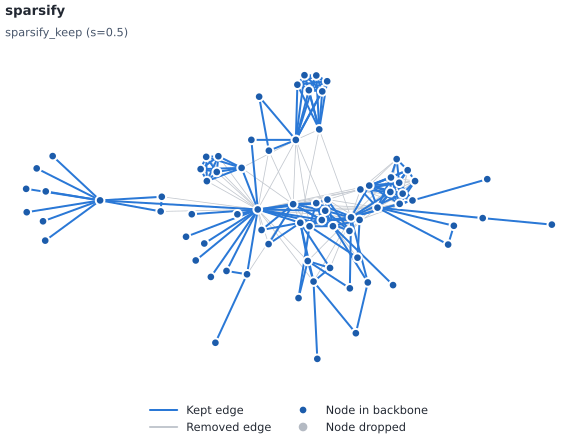
Backbone (blue) over the original graph (gray). Kept 174 of 254 edges (69%) and 77 of 77 nodes.#
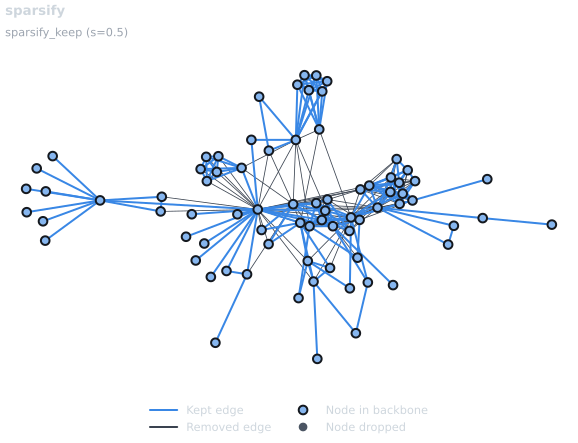
Backbone (blue) over the original graph (gray). Kept 174 of 254 edges (69%) and 77 of 77 nodes.#
lspar() on Les Misérables (unweighted), keeping sparsify_keep (s=0.5).
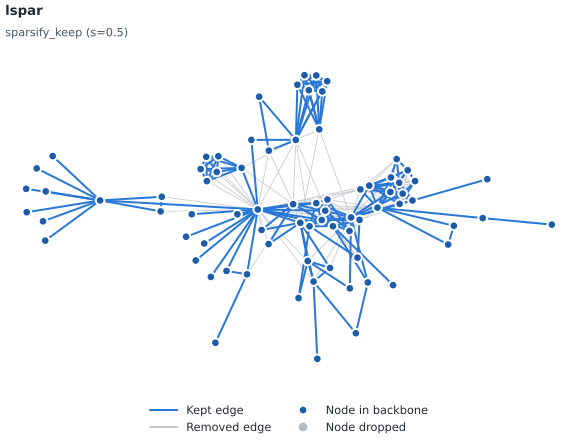
Backbone (blue) over the original graph (gray). Kept 174 of 254 edges (69%) and 77 of 77 nodes.#
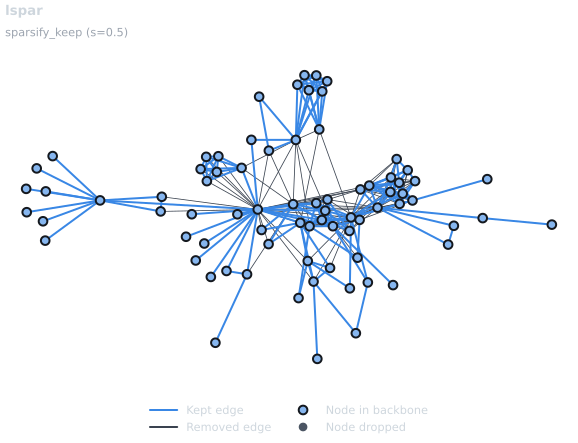
Backbone (blue) over the original graph (gray). Kept 174 of 254 edges (69%) and 77 of 77 nodes.#
local_degree() on Les Misérables (unweighted), keeping sparsify_keep (s=0.3).
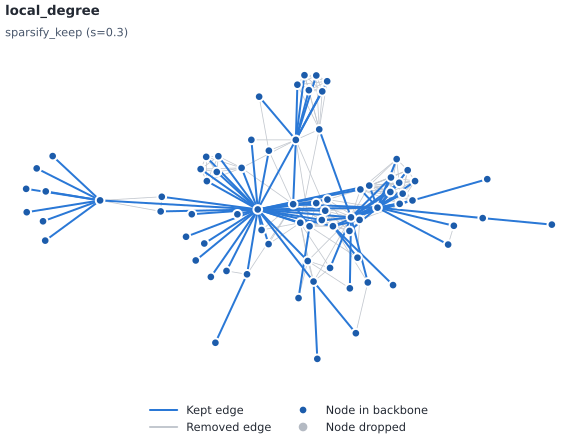
Backbone (blue) over the original graph (gray). Kept 91 of 254 edges (36%) and 77 of 77 nodes.#
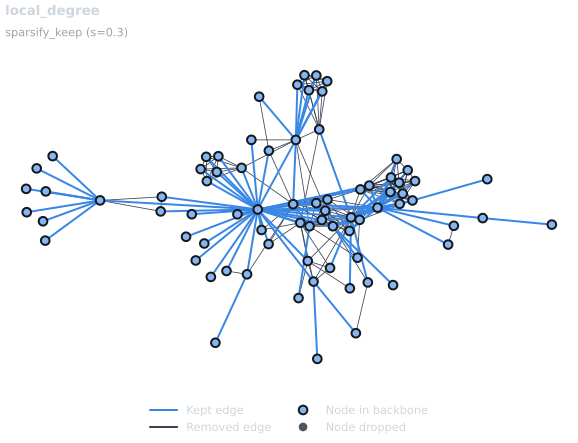
Backbone (blue) over the original graph (gray). Kept 91 of 254 edges (36%) and 77 of 77 nodes.#