Hypergraph Methods#
Methods that operate directly on hypergraphs (collections of arbitrary-size
hyperedges) rather than on dyadic graphs. Inputs are plain iterables of
hyperedges (each hyperedge an iterable of node labels); the backbone is returned
as a list of frozenset hyperedges inside a
HypergraphBackbone result.
The mdl_hypergraph_backbone() method implements the
parameter-free, information-theoretic (minimum description length) backbone of
Kirkley, Felippe, Malizia & Battiston (2026), which prunes nested and redundant
hyperedges and naturally extends to weighted hypergraphs.
local_mdl_hypergraph_backbone() is its local variant
(Appendix E of the paper), which backbones each node’s neighborhood separately.
For a narrative walk-through with figures, see Hypergraph backbones: keeping the groups that matter; for short code recipes, see Hypergraph Backbones.
Hypergraph backbone methods.
These methods operate directly on hypergraphs (collections of hyperedges, where each hyperedge is a set of nodes of arbitrary size) rather than on dyadic graphs.
A hyperedge is given as any iterable of node labels; a hypergraph is an iterable
of hyperedges, for example [(1, 2, 3), (2, 4), (1, 2, 3, 5)]. NetworkX has
no native hypergraph type, so inputs and outputs use plain Python collections
(the backbone is returned as a list of frozenset hyperedges).
Methods#
- mdl_hypergraph_backbone
Parameter-free information-theoretic (MDL) backbone that prunes nested and redundant hyperedges (Kirkley, Felippe, Malizia & Battiston, 2026).
- local_mdl_hypergraph_backbone
Local variant that backbones each node neighborhood separately and aggregates the results (Kirkley et al., 2026, Appendix E).
- hypergraph_compression_ratio
Inverse compression ratio
etaachieved by the MDL backbone.- intersection_graph
Graph linking hyperedges that share at least one node.
- nx_backbone.mdl_hypergraph_backbone(hyperedges, weights=None, gamma=1.0, prior='poisson', method='auto')[source]#
Extract a hypergraph backbone via minimum description length (MDL).
Implements the parameter-free information-theoretic backboning method of Kirkley, Felippe, Malizia & Battiston [1]. The backbone
Bis a subset of hyperedges (“parents”) chosen so that the remaining “child” hyperedges can be cheaply reconstructed from a parent they overlap, exploiting the nested and redundant structure unique to higher-order networks. The optimal backbone minimizes the two-part description lengthL(G, B) = L(B) + L(G|B)(Eqs (1)-(6)); equivalently it maximizes the total parent–child reduced mutual information (Eq. (12)).The method is fully nonparametric for unweighted hypergraphs. Edge weights are incorporated through an empirical-Bayes prior with a single knob gamma trading off weight against topology (Sec. III).
- Parameters:
- hyperedgesiterable of iterables
The hypergraph. Each hyperedge is an iterable of node labels (treated as a set; repeated nodes within a hyperedge are ignored). Duplicate hyperedges are merged.
- weightsiterable of numbers or None, optional (default=None)
Optional per-hyperedge weights (each
>= 1), parallel to hyperedges.Nonemeans an unweighted hypergraph.- gammafloat, optional (default=1.0)
Weight/topology trade-off in
(0, 1](Eq. (14)).gamma=1ignores weights (recovers the unweighted backbone);gamma -> 0makes it increasingly costly to leave a high-weight hyperedge out of the backbone. Ignored when weights isNone.- prior{“poisson”, “geometric”}, optional (default=”poisson”)
Weight prior family (Eqs (16)-(17)). Ignored when weights is
None.- method{“auto”, “edge”, “node”}, optional (default=”auto”)
Greedy optimizer (Kirkley et al. 2026, Appendix D).
"edge"adds parent–child links by decreasing gain;"node"adds backbone parents by decreasing total gain;"auto"runs both and keeps the lower description length (the procedure used in [1]).
- Returns:
- resultHypergraphBackbone
The backbone hyperedges, the parent–child assignment, and compression diagnostics (see
HypergraphBackbone).
- Raises:
- ValueError
If gamma is not in
(0, 1], prior is unknown, weights has the wrong length or contains a value< 1, or method is unsupported.
See also
hypergraph_compression_ratioOnly the compression ratio
eta.maximal_hyperedgesPurely set-inclusion (toplex) pruning.
statistically_validated_hypergraphStatistical hyperedge filtering.
Notes
Exact minimization is combinatorial; this uses the greedy heuristics of [1], which forms a maximum-reward partition of the intersection graph into disjoint stars (each child attached to a single parent). On small inputs the greedy compression matches exhaustive search.
References
Examples
>>> from nx_backbone import mdl_hypergraph_backbone
>>> # A 4-node hyperedge with two nested (redundant) sub-hyperedges.
>>> G = [(1, 2, 3, 4), (1, 2, 3), (2, 3, 4), (8, 9)]
>>> result = mdl_hypergraph_backbone(G)
>>> frozenset({1, 2, 3, 4}) in result.backbone
True
>>> result.compression_ratio <= 1.0
True
Computational complexity estimate is
O(sum_i \|G_i\|^2 + P log P)time andO(m + P)space.
- nx_backbone.local_mdl_hypergraph_backbone(hyperedges, weights=None, gamma=1.0, prior='poisson', aggregation='majority', method='auto')[source]#
Extract the local (per-node neighborhood) MDL hypergraph backbone.
The local variant of
mdl_hypergraph_backbone()from Appendix E of Kirkley, Felippe, Malizia & Battiston [1], the higher-order analogue of the disparity filter. Each nodeihas a neighborhoodG_i = {e in G : i in e}, the hyperedges containing it. The MDL objective is minimized on every neighborhood separately, “considered in isolation” (Eq. (E1)),\[B_i^* = \arg\min_{B_i \subseteq G_i} \mathcal{L}(G_i, B_i),\]and the neighborhood backbones
B_i*are combined into one backboneB^(local)by an aggregation rule. Because each hyperedge is judged only against the other hyperedges of its own nodes, the backbone keeps hyperedges that are informative locally even when the global backbone encodes them as children of a hyperedge elsewhere; local backbones are therefore denser and compress less than the global one [1].- Parameters:
- hyperedgesiterable of iterables
The hypergraph. Each hyperedge is an iterable of node labels (treated as a set). Duplicate hyperedges are merged.
- weightsiterable of numbers or None, optional (default=None)
Optional per-hyperedge weights (each
>= 1), parallel to hyperedges. As in [1], the weighted objectiveL_w(Eq. (13)) then replacesLin every neighborhood.- gammafloat, optional (default=1.0)
Weight/topology trade-off in
(0, 1]; seemdl_hypergraph_backbone(). Ignored when weights isNone.- prior{“poisson”, “geometric”}, optional (default=”poisson”)
Weight prior family. Ignored when weights is
None.- aggregation{“majority”, “union”, “all”}, optional (default=”majority”)
How the neighborhood backbones are combined. A hyperedge
eis kept if it belongs toB_i*for"union": at least one of its nodes (Eq. (E2)); every node then stays in the backbone, but the backbone tends to be dense;"majority": at least half of its nodes (the rule used for Table II of [1]; see Notes);"all": every one of its nodes (the most conservative rule, often very sparse).
- method{“auto”, “edge”, “node”}, optional (default=”auto”)
Greedy optimizer applied to each neighborhood; see
mdl_hypergraph_backbone().
- Returns:
- resultHypergraphBackbone
The local backbone
B^(local)(in input order) withdescription_length= Eq. (E3),baseline_description_length=sum_i L(G_i, G_i)andcompression_ratio=eta^(local)(Eq. (E4)). Per-node results are inlocal_backbones(eachB_i*) andlocal_description_lengths(eachL(G_i, B_i*));aggregationrecords the rule.assignmentis empty, since there is no single global parent–child partition.
- Raises:
- ValueError
If aggregation is unknown, or for any invalid argument of
mdl_hypergraph_backbone().
See also
mdl_hypergraph_backboneThe global MDL backbone.
disparity_filterThe dyadic local backbone this generalises.
Notes
Every hyperedge of
G_icontainsi, so all pairs of hyperedges in a neighborhood overlap and any non-empty subset ofG_iis a valid backbone of it. The neighborhood objectives involveO(sum_i |G_i|^2)hyperedge pairs, as many as the global intersection graph is built from.Appendix E of [1] leaves a few details implicit; this implementation makes the following choices.
“Considered in isolation” is read literally: the node count
N, the number of distinct ordersLand, for weighted input, the mean weight of the empirical-Bayes prior are those ofG_i, not ofG.Majority means at least half of a hyperedge’s nodes. The paper notes that, with the union rule, the majority rule is “consistent with the disparity filter convention for pairwise edges in which the edge is kept […] if it belongs to either node’s neighborhood backbone”; for a two-node hyperedge only the at-least-half reading does that.
In Eq. (E3),
L(G_i, B_i* ∩ B^(local))assigns each remaining hyperedge ofG_ito the parent inB_i* ∩ B^(local)that encodes it most cheaply. If that intersection is empty (possible only under"majority"or"all"), the neighborhood is charged its uncompressed costL(G_i, G_i).The denominator
L^(local)(G, G)of Eq. (E4) is taken assum_i L(G_i, G_i), the cost with no compression in any neighborhood (read literally,B_i* ∩ G = B_i*would makeeta^(local)identically 1 under the union rule). With the union ruleeta^(local) <= 1; with"majority"or"all"it can exceed 1 when dropping a neighborhood’s parents forces costlier encodings of its remaining hyperedges.
References
Examples
A core hyperedge
{0, ..., 5}with two nested sub-hyperedges and two “satellites”, each joining four core nodes to three peripheral nodes of its own. The global backbone encodes the satellite{0, 1, 2, 3, 6, 7, 8}as a child, but it is the only hyperedge in the neighborhoods of nodes 6, 7 and 8, so the local backbone keeps it (while still pruning the nested sub-hyperedges):>>> from nx_backbone import ( ... local_mdl_hypergraph_backbone, ... mdl_hypergraph_backbone, ... ) >>> G = [ ... (0, 1, 2, 3, 4, 5), ... (0, 1, 2, 3, 4), ... (0, 1, 2, 3, 5), ... (0, 1, 2, 3, 6, 7, 8), ... (2, 3, 4, 5, 9, 10, 11), ... ] >>> satellite = frozenset({0, 1, 2, 3, 6, 7, 8}) >>> satellite in mdl_hypergraph_backbone(G).backbone False >>> local = local_mdl_hypergraph_backbone(G) # majority rule >>> satellite in local.backbone True >>> len(local.backbone) 3 >>> local.local_backbones[6] == [satellite] True
Computational complexity estimate is
O(sum_i k \|G_i\|^2 log \|G_i\|)time andO(sum_i \|G_i\|^2)space.
- nx_backbone.hypergraph_compression_ratio(hyperedges, weights=None, gamma=1.0, prior='poisson')[source]#
Inverse compression ratio
etaof the MDL backbone (Eq. (8)).A convenience wrapper returning only
HypergraphBackbone.compression_ratiofrommdl_hypergraph_backbone().etalies in[0, 1]; values near 0 indicate a highly redundant (compressible) hypergraph, whileeta = 1indicates no compressible structure.- Parameters:
- hyperedgesiterable of iterables
The hypergraph.
- weightsiterable of numbers or None, optional (default=None)
Optional per-hyperedge weights.
- gammafloat, optional (default=1.0)
Weight/topology trade-off (see
mdl_hypergraph_backbone()).- prior{“poisson”, “geometric”}, optional (default=”poisson”)
Weight prior family.
- Returns:
- etafloat
Inverse compression ratio in
[0, 1].
- Raises:
- ValueError
For invalid weights, gamma, or prior (see
mdl_hypergraph_backbone()).
See also
mdl_hypergraph_backboneThe full backbone and diagnostics.
Examples
>>> from nx_backbone import hypergraph_compression_ratio
>>> eta = hypergraph_compression_ratio([(1, 2, 3, 4), (1, 2, 3), (2, 3, 4)])
>>> 0.0 <= eta <= 1.0
True
Computational complexity estimate is
O(sum_i \|G_i\|^2 + P log P)time andO(m + P)space.
- nx_backbone.intersection_graph(hyperedges, s=1, weight='overlap')[source]#
Build the intersection graph (or s-line graph) of a hypergraph.
Each hyperedge becomes a node (labeled by its integer index after deduplication); two hyperedges are linked when they share at least s nodes. With
s=1this is the intersection graph over which MDL parent–child relationships are formed (Kirkley et al. 2026, Appendix D); withs > 1it is the s-line graph, the basis of s-connectivity in higher-order networks.- Parameters:
- hyperedgesiterable of iterables
The hypergraph. Each hyperedge is an iterable of node labels.
- sint, optional (default=1)
Minimum shared-node count
|e_i ∩ e_j|for two hyperedges to be linked. Must be>= 1.- weightstring, optional (default=”overlap”)
Edge attribute name used to store the overlap size
|e_i ∩ e_j|.
- Returns:
- Inetworkx.Graph
Graph on hyperedge indices. Each node has a
"members"attribute (the hyperedge as afrozenset); each edge stores the overlap size under weight.
- Raises:
- ValueError
If s is less than 1.
See also
s_componentsConnected components of the s-line graph.
hypergraph_to_bipartiteNode–hyperedge incidence graph.
Examples
>>> from nx_backbone import intersection_graph
>>> I = intersection_graph([(1, 2, 3), (2, 3, 4), (5, 6)])
>>> I.number_of_nodes()
3
>>> I[0][1]["overlap"]
2
>>> intersection_graph([(1, 2, 3), (2, 3, 4), (5, 6)], s=3).number_of_edges()
0
Computational complexity estimate is
O(sum_i \|G_i\|^2)time andO(m + P)space.
- class nx_backbone.HypergraphBackbone(backbone=<factory>, assignment=<factory>, n_nodes=0, n_orders=0, weighted=False, gamma=1.0, prior='poisson', description_length=0.0, baseline_description_length=0.0, compression_ratio=1.0, n_hyperedges=None, aggregation=None, local_backbones=<factory>, local_description_lengths=<factory>)[source]#
Bases:
objectResult of
mdl_hypergraph_backbone()or its local variant.- Attributes:
- backbonelist of frozenset
The retained (“parent”) hyperedges forming the structural backbone.
- assignmentdict
Mapping from each parent hyperedge to the list of child hyperedges it encodes (its star in the intersection graph). Parents with no children are absent from this mapping. Empty for a local backbone, which has no single global star partition (see local_backbones).
- n_nodesint
Number of distinct nodes in the input hypergraph.
- n_ordersint
Number of distinct hyperedge sizes (orders) in the input.
- weightedbool
Whether edge weights influenced the backbone.
- gammafloat
Weight/topology trade-off used (only meaningful when
weighted).- priorstr
Weight prior used (
"poisson"or"geometric").- description_lengthfloat
Description length
L(G, B*)of the input given the backbone (bits).- baseline_description_lengthfloat
Description length
L(G, G)with no backbone (bits).- compression_ratiofloat
Inverse compression ratio
eta = L(G, B*) / L(G, G)in[0, 1]. Smaller means more redundant structure was removed. For a local backbone this iseta^(local)(Eq. (E4)).- n_hyperedgesint or None
Number of distinct (deduplicated, non-empty) input hyperedges, or
Noneif unknown (then derived from backbone and assignment).- aggregationstr or None
For a local backbone, the rule used to combine the neighborhood backbones (
"union","majority"or"all");Nonefor the global backbone.- local_backbonesdict
For a local backbone, a mapping from each node
ito its neighborhood backboneB_i*(a list of frozenset), the MDL optimum of the hyperedges containingi(Eq. (E1)). Empty otherwise.- local_description_lengthsdict
For a local backbone, a mapping from each node
ito the neighborhood optimumL(G_i, B_i*)in bits. Empty otherwise.
Structural methods
Purely structural hypergraph backbones and utilities with no dyadic analog.
These return plain hyperedge collections rather than a
HypergraphBackbone.
- nx_backbone.maximal_hyperedges(hyperedges)[source]#
Inclusion (toplex) reduction: keep only the maximal hyperedges.
Removes every hyperedge that is a strict subset of another hyperedge, retaining the toplexes – hyperedges not contained in any other. This is the simplest structural hypergraph backbone, pruning nested redundancy purely by set inclusion (cf.
HyperNetX’stoplexes). For a richer, information-theoretic treatment of nested and overlapping redundancy, seemdl_hypergraph_backbone().- Parameters:
- hyperedgesiterable of iterables
The hypergraph. Duplicate hyperedges are merged.
- Returns:
- maximallist of frozenset
The maximal hyperedges, ordered by decreasing size (ties broken by sorted node labels; labels of mixed, unorderable types are compared by
repr).
See also
mdl_hypergraph_backboneInformation-theoretic pruning of nested and overlapping redundancy.
order_filterKeep hyperedges by size.
Examples
>>> from nx_backbone import maximal_hyperedges
>>> sorted(map(sorted, maximal_hyperedges([(1, 2, 3), (1, 2), (2, 3), (4, 5)])))
[[1, 2, 3], [4, 5]]
Computational complexity estimate is
O(m^2 * k)time andO(m)space.
- nx_backbone.order_filter(hyperedges, min_order=None, max_order=None, orders=None)[source]#
Keep hyperedges whose order (size) falls in a range or set.
Order-resolved filtering has no analog in dyadic graphs, where every edge has order 2; in a hypergraph it selects interactions at chosen scales.
- Parameters:
- hyperedgesiterable of iterables
The hypergraph. Duplicate hyperedges are merged.
- min_orderint or None, optional (default=None)
Keep hyperedges with size
>= min_order.- max_orderint or None, optional (default=None)
Keep hyperedges with size
<= max_order.- ordersiterable of int or None, optional (default=None)
If given, keep only hyperedges whose size is in this set (applied in addition to min_order/max_order).
- Returns:
- selectedlist of frozenset
The retained hyperedges, in first-occurrence order.
- Raises:
- ValueError
If min_order and max_order are both given and
min_order > max_order.
See also
maximal_hyperedgesStructural (set-inclusion) pruning.
s_componentsGroup hyperedges by s-connectivity.
Examples
>>> from nx_backbone import order_filter
>>> sorted(map(sorted, order_filter([(1, 2), (1, 2, 3), (1, 2, 3, 4)], min_order=3)))
[[1, 2, 3], [1, 2, 3, 4]]
Computational complexity estimate is
O(m)time andO(m)space.
- nx_backbone.s_components(hyperedges, s=1)[source]#
Group hyperedges into s-connected components.
Two hyperedges are s-adjacent when they share at least s nodes; an s-component is a connected component of the resulting s-line graph (
intersection_graph()with the same s). s-connectivity is a higher-order notion with no dyadic counterpart and underlies s-centrality and s-distance analyses of hypergraphs.- Parameters:
- hyperedgesiterable of iterables
The hypergraph. Duplicate hyperedges are merged.
- sint, optional (default=1)
Minimum shared-node count for s-adjacency. Must be
>= 1.
- Returns:
- componentslist of list of frozenset
Each inner list is the hyperedges of one s-connected component, ordered by decreasing component size (ties broken by sorted node labels; labels of mixed, unorderable types are compared by
repr).
- Raises:
- ValueError
If s is less than 1.
See also
intersection_graphThe s-line graph whose components are returned.
maximal_hyperedgesStructural (set-inclusion) pruning.
Examples
>>> from nx_backbone import s_components
>>> comps = s_components([(1, 2, 3), (2, 3, 4), (5, 6, 7)], s=2)
>>> [len(c) for c in comps]
[2, 1]
Computational complexity estimate is
O(sum_i \|G_i\|^2)time andO(m + P)space.
Statistical methods
Hypothesis-testing hypergraph backbones that validate hyperedges/groups
recurring more than expected under a null model (Musciotto, Battiston &
Mantegna, 2021). These require scipy and return a
ValidatedHypergraph. The short names svh and svc
are aliases for the two functions.
- nx_backbone.statistically_validated_hypergraph(hyperedges, weights=None, max_order=None, alpha=0.01)[source]#
Extract the Statistically Validated Hypergraph (SVH).
Keeps the observed hyperedges that recur (co-occur) significantly more often than expected under a null model preserving node activity, following Musciotto, Battiston & Mantegna [1] (the method implemented as
get_svhin Hypergraphx). Each hyperedge of orderkis tested independently per order: withNorder-kinstances and node activitiesd_i(number of order-kinstances containing nodei), the probability of seeing a group co-occur at leastntimes isP(X >= n)forX ~ Binomial(N, prod_i d_i / N). P-values are validated with a Benjamini-Hochberg FDR at level alpha (corrected for the number of possible order-khyperedges).Unlike
mdl_hypergraph_backbone()(an information-theoretic, parameter- free method), this is a statistical hypothesis test requiring a significance level, and is most informative for weighted hypergraphs whose weights are integer interaction multiplicities.- Parameters:
- hyperedgesiterable of iterables
The hypergraph. Duplicate hyperedges are merged (multiplicities summed).
- weightsiterable of int or None, optional (default=None)
Per-hyperedge integer multiplicities (interaction counts).
Nonetreats every hyperedge as occurring once.- max_orderint or None, optional (default=None)
Only test hyperedges up to this order (size).
Nonetests all orders.- alphafloat, optional (default=0.01)
FDR significance level, in
(0, 1].
- Returns:
- resultValidatedHypergraph
The validated hyperedges plus per-hyperedge p-values and counts.
- Raises:
- ValueError
If alpha is not in
(0, 1], or weights has the wrong length or contains a value that is not an integer>= 1.
See also
statistically_validated_coresValidates sub-groups (cores) as well.
mdl_hypergraph_backboneParameter-free information-theoretic backbone.
References
[1]Musciotto, F., Battiston, F., & Mantegna, R. N. (2021). Detecting informative higher-order interactions in statistically validated hypergraphs. Communications Physics, 4, 218.
Examples
>>> from nx_backbone import statistically_validated_hypergraph
>>> edges = [(1, 2), (1, 2), (1, 2), (1, 3), (2, 4), (5, 6)]
>>> result = statistically_validated_hypergraph(edges)
>>> isinstance(result.validated, list)
True
Computational complexity estimate is
O(sum_e \|e\| + m log m)time andO(m + n)space.
- nx_backbone.statistically_validated_cores(hyperedges, weights=None, min_order=2, max_order=None, alpha=0.01, max_groups=1000000)[source]#
Extract the Statistically Validated Cores (SVC).
A complement to
statistically_validated_hypergraph()that validates significant groups (cores) of nodes, including sub-groups that are not themselves present as a single hyperedge (theget_svcmethod of Hypergraphx, built on [1]). Orders are processed from high to low; once a core is validated, its sub-combinations are not re-tested at lower orders, so significance is attributed to the largest validated group. The co-occurrence of a group is the number of hyperedge instances (of any order) containing it, tested againstBinomial(N, prod_i d_i / N)with global node activities, and validated with the same Benjamini-Hochberg FDR as SVH.- Parameters:
- hyperedgesiterable of iterables
The hypergraph. Duplicate hyperedges are merged (multiplicities summed).
- weightsiterable of int or None, optional (default=None)
Per-hyperedge integer multiplicities.
Nonetreats each as occurring once.- min_orderint, optional (default=2)
Smallest group size to test (
>= 1).- max_orderint or None, optional (default=None)
Largest group size to test.
Noneuses the largest hyperedge size. Every sub-group of every hyperedge up to this size is enumerated – up to2**kper hyperedge of sizek– so set it when the hypergraph contains large hyperedges.- alphafloat, optional (default=0.01)
FDR significance level, in
(0, 1].- max_groupsint or None, optional (default=1_000_000)
Safety guard: if the number of candidate sub-groups to enumerate (summed over the distinct hyperedges, for orders
min_order..max_order) exceeds this, aValueErroris raised before any work is done instead of running for an impractically long time.Nonedisables the guard.
- Returns:
- resultValidatedHypergraph
The validated cores plus per-group p-values and co-occurrence counts.
- Raises:
- ValueError
If alpha is not in
(0, 1], min_order is less than 1, weights is invalid, or the enumeration would exceed max_groups (lower max_order, or raise / disable max_groups).
See also
statistically_validated_hypergraphValidates only observed hyperedges.
maximal_hyperedgesPurely structural pruning of nested hyperedges.
References
[1]Musciotto, F., Battiston, F., & Mantegna, R. N. (2021). Detecting informative higher-order interactions in statistically validated hypergraphs. Communications Physics, 4, 218.
Examples
>>> from nx_backbone import statistically_validated_cores
>>> edges = [(1, 2, 3), (1, 2, 3), (1, 2, 3), (1, 4), (2, 5)]
>>> result = statistically_validated_cores(edges)
>>> result.method
'svc'
>>> # A single 24-node hyperedge has ~16.7 million sub-groups: bound the order.
>>> big = [tuple(range(24)), (0, 1), (0, 1), (0, 1)]
>>> len(statistically_validated_cores(big, max_order=3).pvalues)
2300
Computational complexity estimate is
O(sum_e 2^\|e\|)time andO(G)space.
- class nx_backbone.ValidatedHypergraph(validated=<factory>, pvalues=<factory>, counts=<factory>, alpha=0.01, method='svh', n_nodes=0, n_instances=0)[source]#
Bases:
objectResult of
statistically_validated_hypergraph()/ cores.- Attributes:
- validatedlist of frozenset
The statistically validated hyperedges (SVH) or cores (SVC) – the sub-hypergraph that survived FDR validation.
- pvaluesdict
Mapping from each tested hyperedge/group to its p-value.
- countsdict
Mapping from each tested hyperedge/group to its observed co-occurrence count (multiplicity for SVH; number of containing instances for SVC).
- alphafloat
Significance level used for FDR validation.
- methodstr
"svh"or"svc".- n_nodesint
Number of distinct nodes in the input hypergraph.
- n_instancesint
Total number of hyperedge instances (sum of multiplicities).
Method gallery
mdl_hypergraph_backbone() on the Davis Southern Women hypergraph (each of the 14 events is a hyperedge on the women who attended it), global MDL, parameter-free.
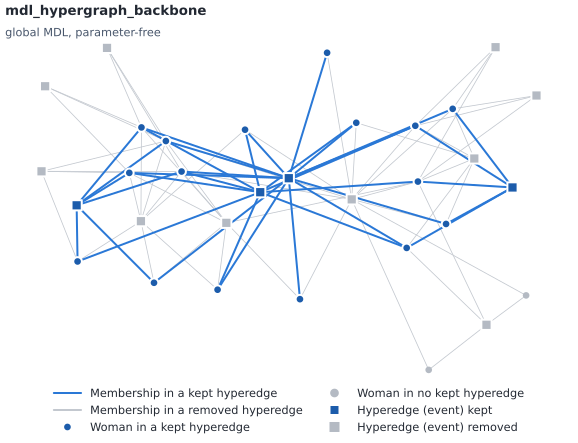
Kept hyperedges in blue. Kept 4 of 14 hyperedges, covering 16 of 18 women.#
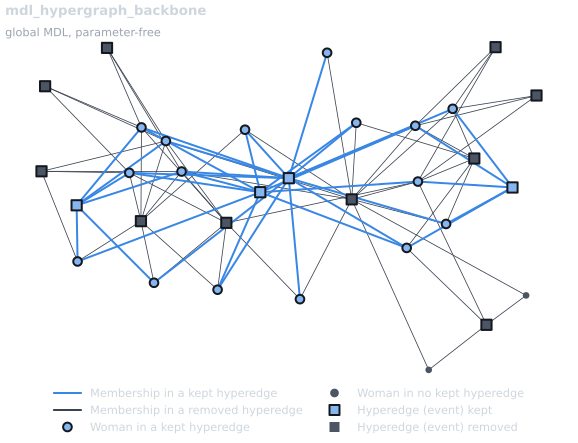
Kept hyperedges in blue. Kept 4 of 14 hyperedges, covering 16 of 18 women.#
local_mdl_hypergraph_backbone() on the Davis Southern Women hypergraph (each of the 14 events is a hyperedge on the women who attended it), local MDL, defaults.
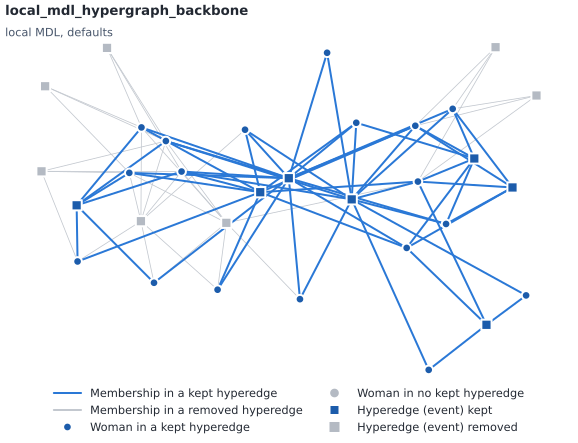
Kept hyperedges in blue. Kept 7 of 14 hyperedges, covering 18 of 18 women.#
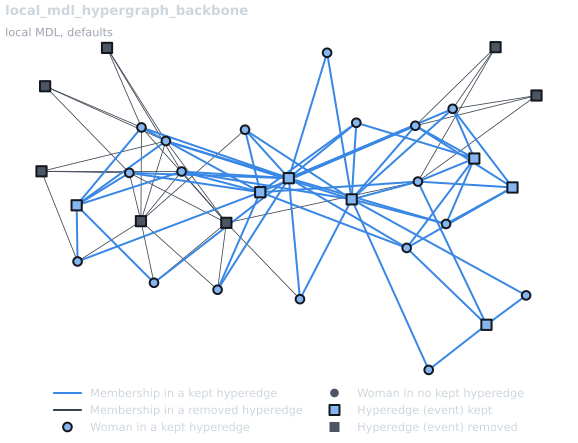
Kept hyperedges in blue. Kept 7 of 14 hyperedges, covering 18 of 18 women.#
Interoperability and ingestion
Convert between the hyperedge-list representation and a NetworkX incidence
bipartite graph (enabling the bipartite projection backbones), the HIF
interchange format, and the xgi / HyperNetX / HypergraphX / HAT
hypergraph classes. The third-party libraries are optional and imported lazily.
Hypergraph ingestion and interoperability adapters.
nx_backbone represents a hypergraph as a plain iterable of hyperedges
(each an iterable of node labels), which every hypergraph backbone method in
nx_backbone.hypergraph consumes. This module converts that
representation to and from:
a NetworkX incidence bipartite graph, so bipartite projection backbones (
sdsm(),fdsm(), …) can be applied to hypergraphs;the HIF (Hypergraph Interchange Format) JSON standard;
the xgi, HyperNetX, HypergraphX, and Hypergraph Analysis Toolbox (HAT) hypergraph classes.
The third-party libraries are imported lazily; none is a required dependency. HIF is the recommended interchange path because all four libraries read and write it, so it needs only the standard library.
- nx_backbone.hypergraph_to_bipartite(hyperedges, edge_prefix='he')[source]#
Convert a hypergraph to its incidence bipartite graph.
Nodes of the hypergraph form one partition (
bipartite=0); hyperedges form the other (bipartite=1). Thei-th (non-empty) hyperedge becomes the node(edge_prefix, i)– a tuple label, so it cannot be confused with a string node label such as"he0"– carrying a"members"attribute with the hyperedge as afrozenset. The result is exactly the input expected by the bipartite projection backbones, so a hypergraph can be backboned with, e.g.,sdsm()orfdsm().- Parameters:
- hyperedgesiterable of iterables
The hypergraph. Empty hyperedges are skipped.
- edge_prefixhashable, optional (default=”he”)
First element of the
(edge_prefix, i)hyperedge-node labels.
- Returns:
- Bnetworkx.Graph
The incidence bipartite graph.
- nodeslist
The hypergraph’s nodes (the agent partition), suitable to pass as
agent_nodesto the bipartite methods. Sorted in natural order when the labels are mutually comparable, otherwise byrepr.
- Raises:
- ValueError
If a hyperedge label
(edge_prefix, i)coincides with a hypergraph node label (choose a different edge_prefix).
See also
sdsm,fdsmBipartite projection backbones that consume the result.
intersection_graphHyperedge-level (line-graph) view of a hypergraph.
Examples
>>> import networkx as nx
>>> import nx_backbone as nb
>>> B, nodes = nb.hypergraph_to_bipartite([(1, 2, 3), (2, 3, 4), (5, 6)])
>>> nx.is_bipartite(B)
True
>>> nodes
[1, 2, 3, 4, 5, 6]
>>> sorted(B[("he", 0)])
[1, 2, 3]
>>> scored = nb.sdsm(B, agent_nodes=nodes)
- nx_backbone.read_hif(source, return_weights=False)[source]#
Read a hypergraph from the HIF (Hypergraph Interchange Format) standard.
JSON arrays used as node or edge identifiers are converted to tuples so they are hashable (this restores tuple node labels written by
write_hif()).- Parameters:
- sourcedict, str, path, or file-like
A parsed HIF dictionary, a path to a HIF JSON file, or an open file.
- return_weightsbool, optional (default=False)
If
True, also return per-hyperedge weights, read from eachedgesrecord’sweight(orattrs["weight"]) and defaulting to 1.
- Returns:
- hyperedgeslist of frozenset
The hyperedges, in order of first appearance among the incidences.
- weightslist of numbers
Returned only when return_weights is
True.
- Raises:
- TypeError
If source is not a dict, path, or file-like object.
- networkx.NetworkXNotImplemented
If the HIF
network-typeis"directed"(directed hyperedges would otherwise silently lose their head/tail orientation).- ValueError
If the HIF
network-typeis not a recognized value.
See also
write_hifThe inverse operation.
Examples
>>> import nx_backbone as nb
>>> hif = nb.write_hif([(1, 2, 3), (3, 4)], weights=[2, 1])
>>> edges, weights = nb.read_hif(hif, return_weights=True)
>>> [sorted(e) for e in edges], weights
([[1, 2, 3], [3, 4]], [2, 1])
- nx_backbone.write_hif(hyperedges, target=None, weights=None, network_type='undirected')[source]#
Serialise a hypergraph to the HIF (Hypergraph Interchange Format) standard.
HIF is a JSON format shared by xgi, HyperNetX, HypergraphX, and HAT, making it the most portable interchange path. Numpy scalar node labels and weights are converted to builtin Python numbers so the result is JSON-serialisable. Tuple node labels are written as JSON arrays and restored as tuples by
read_hif().The output always has
nodesandedgeslists, which the HAT and HypergraphX readers require. Hyperedge weights go in the edge records’weightfield, as the HIF schema specifies. HyperNetX and HAT read them; xgi’s reader keeps onlyattrsand HypergraphX’s ignores weights, so for those two useto_xgi(*read_hif(path, return_weights=True))(orto_hypergraphx()) instead of the library’s own reader.- Parameters:
- hyperedgesiterable of iterables
The hypergraph. Empty hyperedges are skipped.
- targetstr, path, file-like, or None, optional (default=None)
Where to write. If
None, the HIF dictionary is returned instead of being written.- weightsiterable of numbers or None, optional (default=None)
Optional per-hyperedge weights, written to the HIF
edgeslist.- network_type{“undirected”, “asc”}, optional (default=”undirected”)
Value for the HIF
network-typefield.
- Returns:
- resultdict or target
The HIF dictionary if target is
None; otherwise target.
- Raises:
- ValueError
If weights does not match hyperedges in length, or network_type is not a valid HIF network type.
- networkx.NetworkXNotImplemented
If network_type is
"directed"(hyperedges here are undirected).
See also
read_hifThe inverse operation.
Examples
>>> import nx_backbone as nb
>>> hif = nb.write_hif([(1, 2, 3), (3, 4)], weights=[2, 1])
>>> hif["network-type"]
'undirected'
>>> len(hif["incidences"])
5
>>> hif["edges"]
[{'edge': 0, 'weight': 2}, {'edge': 1, 'weight': 1}]
>>> hif["nodes"][:2]
[{'node': 1}, {'node': 2}]
- nx_backbone.from_xgi(H, return_weights=False)[source]#
Convert an
xgi.Hypergraphto a list offrozensethyperedges.- Parameters:
- Hxgi.Hypergraph
The xgi hypergraph (read via
H.edges.members(dtype=dict)).- return_weightsbool, optional (default=False)
If
True, also return each edge’s"weight"attribute (default 1).
- Returns:
- hyperedgeslist of frozenset
One frozenset per xgi hyperedge, in xgi’s edge order. Multi-edges are kept; edge IDs are discarded.
- weightslist of numbers
Returned only when return_weights is
True.
Examples
>>> import xgi
>>> import nx_backbone as nb
>>> nb.from_xgi(xgi.Hypergraph([[1, 2, 3], [3, 4]]))
[frozenset({1, 2, 3}), frozenset({3, 4})]
- nx_backbone.to_xgi(hyperedges, weights=None)[source]#
Convert hyperedges to an
xgi.Hypergraph.- Parameters:
- hyperedgesiterable of iterables
The hypergraph. Empty hyperedges are skipped; the remaining edges get the IDs
0, 1, 2, .... Repeated hyperedges become xgi multi-edges.- weightsiterable of numbers or None, optional (default=None)
Per-hyperedge weights (aligned with hyperedges), stored as the
"weight"edge attribute.
- Returns:
- Hxgi.Hypergraph
The equivalent xgi hypergraph.
- Raises:
- ImportError
If
xgiis not installed.- ValueError
If weights does not match hyperedges in length.
Examples
>>> import nx_backbone as nb
>>> H = nb.to_xgi([(1, 2, 3), (3, 4)], weights=[2.0, 1.0])
>>> H.num_edges
2
- nx_backbone.from_hypernetx(H, return_weights=False)[source]#
Convert a
hypernetx.Hypergraphto a list offrozensethyperedges.- Parameters:
- Hhypernetx.Hypergraph
The HyperNetX hypergraph (read via
H.incidence_dict).- return_weightsbool, optional (default=False)
If
True, also return each edge’s HyperNetXweightproperty (HyperNetX defaults it to 1 and stores it as a float).
- Returns:
- hyperedgeslist of frozenset
One frozenset per HyperNetX edge, in
incidence_dictorder (edge names are discarded).- weightslist of numbers
Returned only when return_weights is
True.
See also
to_hypernetxThe inverse conversion.
read_hifLibrary-independent interchange via HIF.
Examples
>>> import hypernetx as hnx
>>> import nx_backbone as nb
>>> nb.from_hypernetx(hnx.Hypergraph({"a": [1, 2], "b": [2, 3]}))
[frozenset({1, 2}), frozenset({2, 3})]
- nx_backbone.to_hypernetx(hyperedges, weights=None)[source]#
Convert hyperedges to a
hypernetx.Hypergraph.- Parameters:
- hyperedgesiterable of iterables
The hypergraph. Empty hyperedges are skipped; the remaining edges are named
0, 1, 2, ....- weightsiterable of numbers or None, optional (default=None)
Per-hyperedge weights (aligned with hyperedges), stored as the HyperNetX edge
weightproperty.
- Returns:
- Hhypernetx.Hypergraph
The equivalent HyperNetX hypergraph.
- Raises:
- ImportError
If
hypernetxis not installed.- ValueError
If weights does not match hyperedges in length.
See also
from_hypernetxThe inverse conversion.
write_hifLibrary-independent interchange via HIF.
Examples
>>> import nx_backbone as nb
>>> H = nb.to_hypernetx([(1, 2, 3), (3, 4)])
>>> sorted(H.incidence_dict)
[0, 1]
- nx_backbone.from_hypergraphx(H, return_weights=False)[source]#
Convert a
hypergraphx.Hypergraphto a list offrozensethyperedges.- Parameters:
- Hhypergraphx.Hypergraph
The HypergraphX hypergraph (read via
H.get_edges()).- return_weightsbool, optional (default=False)
If
True, also return each edge’s weight (H.get_weight; 1 in an unweighted HypergraphX hypergraph).
- Returns:
- hyperedgeslist of frozenset
One frozenset per HypergraphX hyperedge.
- weightslist of numbers
Returned only when return_weights is
True.
See also
to_hypergraphxThe inverse conversion.
read_hifLibrary-independent interchange via HIF.
Examples
>>> import hypergraphx as hgx
>>> import nx_backbone as nb
>>> nb.from_hypergraphx(hgx.Hypergraph(edge_list=[(1, 2), (2, 3, 4)]))
[frozenset({1, 2}), frozenset({2, 3, 4})]
- nx_backbone.to_hypergraphx(hyperedges, weights=None)[source]#
Convert hyperedges to a
hypergraphx.Hypergraph.HypergraphX has no multi-edges, so repeated hyperedges are merged into one edge whose weight is the sum of theirs (each counts 1 when weights is
None). The result is weighted when weights is given or a hyperedge repeats, and unweighted otherwise.- Parameters:
- hyperedgesiterable of iterables
The hypergraph. Empty hyperedges are skipped. HypergraphX sorts the nodes of each hyperedge, so node labels must be mutually comparable.
- weightsiterable of numbers or None, optional (default=None)
Per-hyperedge weights (aligned with hyperedges).
- Returns:
- Hhypergraphx.Hypergraph
The equivalent HypergraphX hypergraph (built from an
edge_listof tuples).
- Raises:
- ImportError
If
hypergraphxis not installed.- ValueError
If weights does not match hyperedges in length.
- TypeError
If the node labels of a hyperedge cannot be sorted (for example, a mix of
intandstr).
See also
from_hypergraphxThe inverse conversion.
write_hifLibrary-independent interchange via HIF.
Examples
>>> import nx_backbone as nb
>>> H = nb.to_hypergraphx([(1, 2, 3), (3, 4), (3, 4)])
>>> nb.from_hypergraphx(H, return_weights=True)
([frozenset({1, 2, 3}), frozenset({3, 4})], [1, 2])
- nx_backbone.from_hat(H, return_weights=False)[source]#
Convert a HAT
Hypergraphto a list offrozensethyperedges.HAT stores nodes by position (row of the incidence matrix). Node labels are read from the
"Names"column ofH.nodeswhen it exists (HAT fills it when built from labeled edges, andto_hat()sets it), else from its"Nodes"column (row indices, or the HIF node IDs for a hypergraph fromHAT.Hypergraph.from_hif), else the row indices.- Parameters:
- HHAT.Hypergraph
The HAT hypergraph. Its node-by-edge incidence matrix is read from the
IM,incidence_matrix, orincidenceMatrixattribute (dense or scipy sparse; a method is called).- return_weightsbool, optional (default=False)
If
True, also return the"weight"column ofH.edges(default 1).
- Returns:
- hyperedgeslist of frozenset
One frozenset per non-empty incidence-matrix column.
- weightslist of numbers
Returned only when return_weights is
True.
- Raises:
- ImportError
If
numpyis not installed.- AttributeError
If no incidence matrix can be found on H.
Examples
>>> import nx_backbone as nb
>>> H = nb.to_hat([("a", "b"), ("b", "c", "d")])
>>> nb.from_hat(H)
[frozenset({'a', 'b'}), frozenset({'b', 'c', 'd'})]
- nx_backbone.to_hat(hyperedges, weights=None)[source]#
Convert hyperedges to a HAT
Hypergraphvia an incidence matrix.HAT is positional: node
iis rowiof the incidence matrix. Rows follow sorted label order (natural order when the labels are mutually comparable, otherwise byrepr), and the labels are kept in the"Names"column ofH.nodes, wherefrom_hat()finds them. Repeated hyperedges are kept (HAT’s own duplicate removal is turned off).- Parameters:
- hyperedgesiterable of iterables
The hypergraph. Empty hyperedges are skipped.
- weightsiterable of numbers or None, optional (default=None)
Per-hyperedge weights (aligned with hyperedges), stored in the
"weight"column ofH.edges(HAT’sedge_weights).
- Returns:
- HHAT.Hypergraph
A HAT hypergraph built from the
nodes x hyperedges0/1 incidence matrix (HAT.Hypergraph(incidence_matrix=..., compress=False)).
- Raises:
- ImportError
If
numpyorHAT(pip install HypergraphAnalysisToolbox) is not installed.- ValueError
If weights does not match hyperedges in length.
Examples
>>> import nx_backbone as nb
>>> H = nb.to_hat([("a", "b"), ("b", "c", "d")], weights=[2, 1])
>>> list(H.edge_weights)
[2, 1]