Roadmap#
This page tracks where nx-backbone is headed: what was finished
recently, known gaps against the cited methods, and planned features. It
consolidates the design notes in docs/design/ (the
Backbone 3.0 coverage evaluation,
the Yassin et al. (2025) coverage evaluation,
the hypergraph backboning proposal,
the generalized null distributions report,
and the temporal backbones proposal).
Each open item links to its GitHub issue; #31 tracks them all.
Contributions are welcome. Please comment on an issue before starting one
of the larger items.
Status key: done, next (planned for the next release), planned, idea (open for discussion).
Roadmap at a glance#
These figures and the table below are generated from this page every time the documentation is built, so they always match the lists that follow.
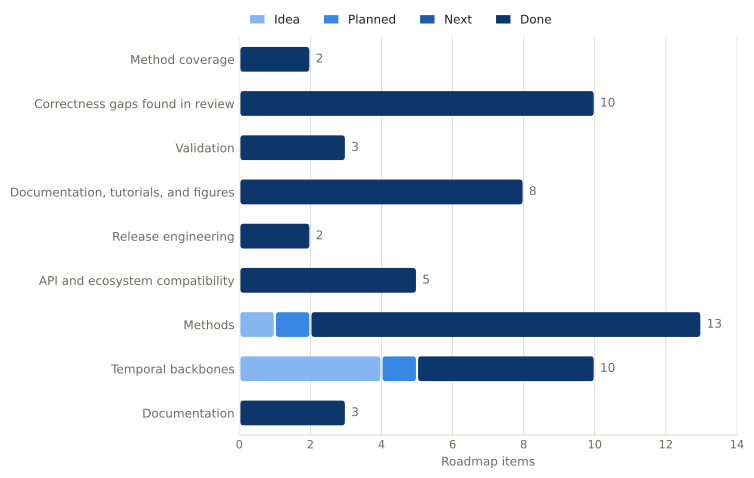
Roadmap items per section, by status.#
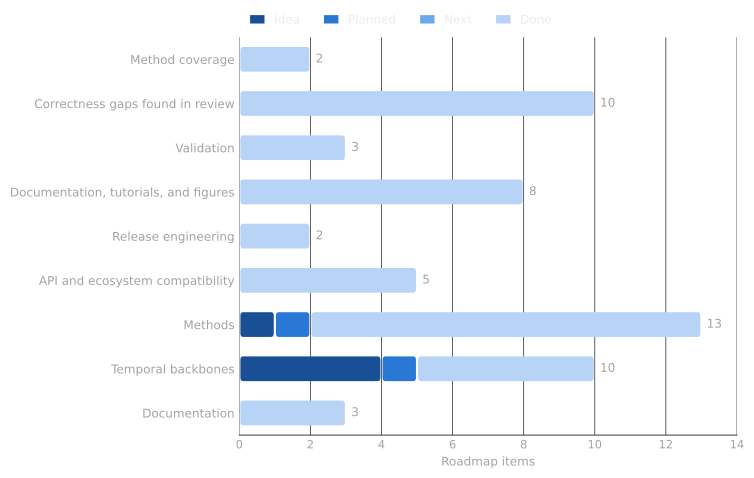
Roadmap items per section, by status.#
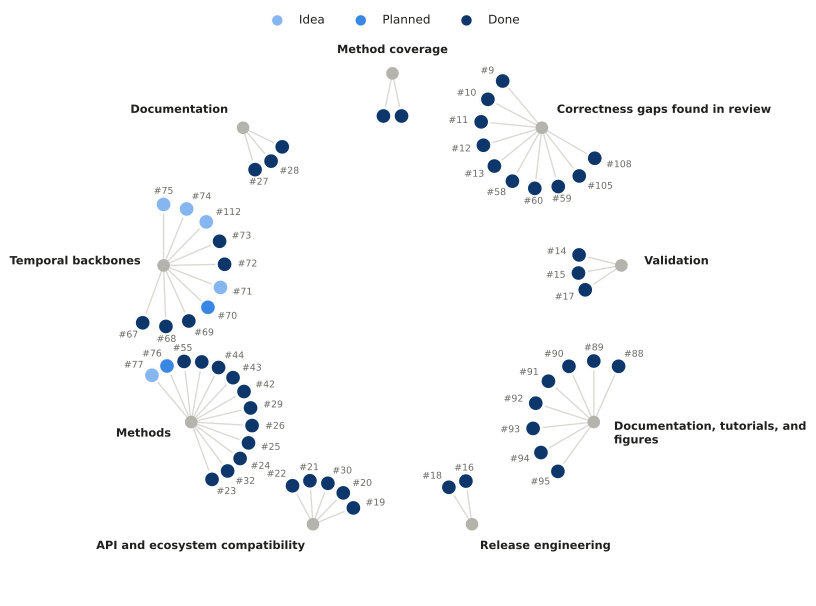
Each section (gray) and its items, colored by status and labeled with their GitHub issue numbers.#
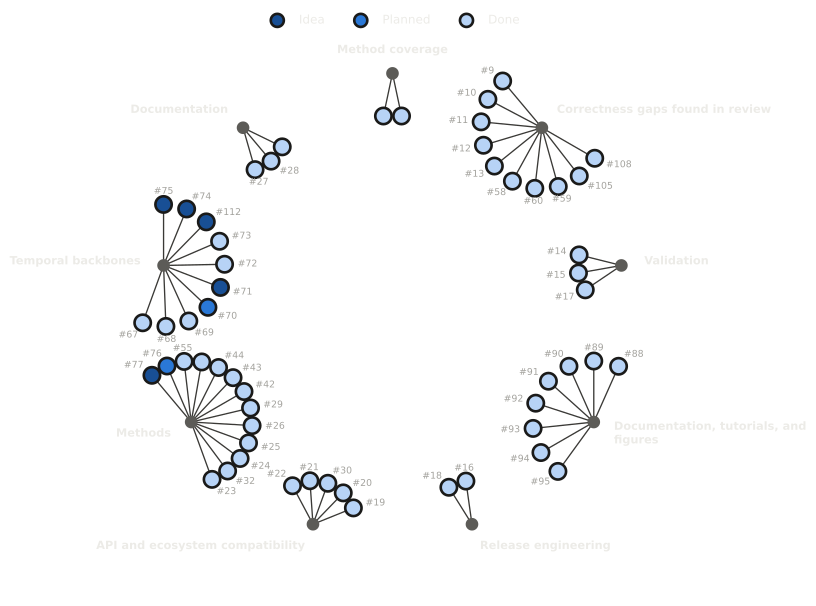
Each section (gray) and its items, colored by status and labeled with their GitHub issue numbers.#
Section |
Idea |
Planned |
Next |
Done |
Total |
|---|---|---|---|---|---|
Recently completed: Method coverage |
0 |
0 |
0 |
2 |
2 |
Next release (0.3.0): Correctness gaps found in review |
0 |
0 |
0 |
10 |
10 |
Next release (0.3.0): Validation |
0 |
0 |
0 |
3 |
3 |
Next release (0.3.0): Documentation, tutorials, and figures |
0 |
0 |
0 |
8 |
8 |
Next release (0.3.0): Release engineering |
0 |
0 |
0 |
2 |
2 |
Planned features: API and ecosystem compatibility |
0 |
0 |
0 |
5 |
5 |
Planned features: Methods |
1 |
1 |
0 |
11 |
13 |
Planned features: Temporal backbones |
4 |
1 |
0 |
5 |
10 |
Planned features: Documentation |
0 |
0 |
0 |
3 |
3 |
All sections |
5 |
2 |
0 |
49 |
56 |
Recently completed#
Method coverage#
done: Every backbone model in Neal’s Backbone 3.0 R package, plus its cross-cutting features: multiple-testing correction (
mtc), signed backbones, and SDSM-EC edge constraints.done: Hypergraph backbones: the MDL backbone (Kirkley et al., 2026), statistically validated hypergraphs and cores (SVH/SVC), structural reductions, and HIF/xgi/HyperNetX/HypergraphX/HAT interoperability.
Correctness review (2026-11)#
A full code review checked each method against its paper. The fixes below change numerical results, so they are listed in the Changelog as breaking changes:
ecm_filter: the solver did not converge and every p-value was about 0. It is now a maximum-likelihood fit with a Newton polish, using the geometric tail \(p_{ij}(y_iy_j)^{w-1}\).marginal_likelihood_filter: now Dianati’s null model \(B(T, s_is_j/2T^2)\). The old one was asymmetric and depended on the order nodes were added.glab_filter: now uses per-node shortest-path involvement and \((1-I_{ij})^{(k_i-1)^c}\) (Zhang et al., 2014) instead of global edge betweenness.disparity_filteron directed graphs: now also tests the target’s incoming links (Serrano et al., 2009).Bipartite: the FDSM null now preserves degrees (a curveball chain with burn-in, and p-values of
(count + 1) / (trials + 1)). The BiCM is fitted exactly, with exact or RNA Poisson-binomial tails. SDSM-EC refits on the free cells.fixedfillandfixedcoluse their exact null distributions.backbone_from_projectionthresholds every method atalpha.See the Changelog for the full bipartite, hypergraph, and structural lists.
Shared conventions: every scorer rejects multigraphs, rejects NaN or infinite weights, works with node labels of mixed types, and preserves graph, node, and edge attributes through the filters.
CI now runs tests on every push and pull request (Python 3.12-3.14 and a NetworkX-only job), along with ruff lint and format checks and doctests.
Next release (0.3.0)#
Correctness gaps found in review#
done (#9):
noise_corrected_filteris a binomial z-score. Implement the full Bayesian noise-corrected backbone of Coscia & Neffke (2017): the posterior variance from the beta prior plus the delta method, and the transformed lift score. Keep the current score as an option for backward compatibility.done (#10): The dominance-fitting multiple linkage analysis is implemented (
method="dominance"). Its fit is the coefficient of determination, checked against Table 1 of Van Nuffel, Derudder & Witlox (2010); the whole-profile sum of squares and Weaver’s variance are available throughdeviation=. The 2007 paper itself is paywalled and was not read.done (#11, contributed in #34): Directed
lans_filternow also tests the target’s in-links.done (#12): A directed GLAB variant, using the out- and in-involvement of Zhang et al. (2014), Section 2.3.
done (#13): Check
hyper_projection’s weighting (\(1/d(z)\) versus Newman’s \(1/(d(z)-1)\)) and the arXiv identifier cited for the projection methods against Coscia & Neffke (2017).done (#58): The signed
lans_filterlower tail is now#{weights < w} / k, the mirror image of the upper tail, as in R. Its two-sided p-values equal R’s, and since #59 so do the signs of exact ties. Les Misérables: 0 -> 126 negative links, as in R (40 of them ties).done (#60):
strongest_n_tieskeeps edges tied at each node’s cutoff together, soG,G.copy(), and any reordering of the same graph give the same backbone.global_sparsificationandedge_betweenness_filterno longer depend on edge orientation.planar_maximally_filtered_graphandmaximum_spanning_tree_backbone(ties in weight),fraction_filter(ties in score, documented), andmodularity_backbone(Louvain visiting order, even with a fixed seed) still depend on input order.done (#59): Decide, for each convention difference from R
backboneandnetbonethat the reference tests document, whether to keep it, match the reference, or add an option. The decision note measures each difference on the reference datasets and records the decisions: every difference is kept and documented, except the sign of an exact tie between the two tails, which now matches R (-1), so every signed weighted backbone equals R’s on the fixtures. R-compatible options are available without changing any default:backbone_from_projection(missing_as_zero=False)andlspar(convention="r").done (#105):
noise_corrected_filter’s p-values were far too small on low-count graphs (pure-noise edges at p ≈ 1e-66), because the paper’sdeltarule is not a calibrated test.nc_pvalueis now the exact binomial tail of the method’s null model (the paper’s footnote 2), checked by simulation; thedeltarule’s p-value ispvalue_method="delta". Les Misérables: 195 -> 126 edges.done (#108):
sdsm(pvalue_method="auto")computes exact Poisson-binomial tails whenever that is affordable, instead of the refined normal approximation above 200 artifacts, whose far upper tail let pure-noise pairs pass a BH correction on sparse data. Truncated convolutions make the exact tails 8-60x cheaper; over budget, the pairs with the smallest expected co-occurrence keep exact tails and a warning names the rest.pvalue_method="rna"still matches Rbackbone.
Validation#
done (#14): Cross-implementation reference tests. P-values and backbones on Les Misérables, Davis Southern Women, and karate are pinned against R
backbone3.0.4 andnetbone0.2.3 in JSON fixtures, so the test suite needs neither R nor netbone.done (#15): An optional “Interop” CI workflow that installs xgi, HyperNetX, HypergraphX, and HAT (the
[interop]extra) and runs the adapter and HIF round-trip tests against the real libraries on pull requests and weekly. Supported versions are listed in Installation.done (#17): Turn on numpydoc validation (
numpydoc_validation_checks) in the docs build so missing Parameters, Returns, or Examples sections fail CI.
Documentation, tutorials, and figures#
Longer, narrative documentation with figures, tracked in #96. Each tutorial is executed when the docs are built, so its numbers and figures cannot drift from the code, and uses one colorblind-safe figure style.
done (#88): Regenerate and redesign the per-method gallery on the API pages, whose images dated from 0.2.0 and showed pre-fix results, and generate it at build time so it cannot go stale. Every figure uses the shared figure style (
docs/_figures/style.py) that the examples and tutorials also use.done (#89): Narrative tutorial: from a hairball to a backbone, end to end (why a backbone, scoring vs filtering, choosing alpha and corrections, comparing, validating, reporting), the “Start here” entry point of the tutorials.
done (#90): Narrative tutorial: the statistical null models side by side, including generalized nulls and signed backbones.
done (#91): Narrative tutorial: structural and proximity backbones, and when topology-based guarantees beat significance tests.
done (#92): Narrative tutorial: bipartite projections and their backbones.
done (#93): Narrative tutorial: hypergraph backbones (groups versus pairs, the MDL and local MDL backbones, SVH and SVC, the structural helpers, and HIF interchange), executed with six figures.
done (#94): Narrative tutorial: temporal backbones, from snapshots to smoothing.
done (#95): Narrative guides: coming from R
backboneornetbone, and scaling up to large networks.
Release engineering#
done (#16): Release
v0.3.0, the first release with this sprint’s correctness fixes, new methods, and changes in results, and the first asnx-backbone(#119). Released 2026-11-02 to PyPI from the tag-checked workflow (v0.2.0never reached PyPI: its tag still had a staticversion = "0.1.0"). The anaconda.org package is still to come: the conda build failed before building (conda-verifyhas no Python 3.12 build).done (#18): Add
py.typedand type annotations for the public API, checked by a non-strict mypy CI job.
Planned features#
API and ecosystem compatibility#
done (#19): NetworkX backend dispatching (
@nx._dispatchable) so backends such asnx-cugraphandnx-parallelcan accelerate the shortest-path-heavy methods (salience, metric backbone, GLAB). The graph-in, graph-out functions dispatch asbackbone_*, the tests pass underNETWORKX_TEST_BACKEND=nx_loopback, and Backends records nx-parallel timings.done (#20): Accept SciPy sparse arrays and pandas edge lists as input: bipartite functions take incidence matrices, and
backbone,backbone_from_weightedandbackbone_from_unweightedtake adjacency matrices and edge lists viato_graph(), matching how NetworkX interoperates with the NumPy/SciPy/pandas stack.done (#30): Make the bipartite and projection code fully sparse (no dense agent-by-artifact matrices). The per-pair loops are already vectorized.
done (#21): A sparse or blockwise ECM solver for graphs with more than about 2,000 nodes. The fit now runs over degree-strength classes with chunked pair sums and Newton or Newton-CG steps.
done (#22): An
asvbenchmark suite, so performance regressions show up in review.
Methods#
done (#23):
describe_backbone(Backbone 3.0’snarrative): methods text and citations for a chosen backbone and its parameters.done (#32):
sparsify(umst=True)should add the union of all minimum spanning trees (Hamann et al., 2016), not a single spanning forest.done (#24): The local (per-node-neighborhood) MDL hypergraph backbone (Kirkley et al., 2026, Appendix E):
local_mdl_hypergraph_backbone.done (#25): Signed variants of
ecm_filterand the noise-corrected filter, for parity with the other scorers’signed=True.done (#26): A
missing_as_zerotoggle for weighted inputs (Backbone 3.0), for testing absent dyads.done (#29): Survey the methods in the Yassin et al. (2025) statistical and structural comparisons. With #42-#44 the package covers all 15 methods; see the coverage table.
done (#42): The Pólya urn filter (Marcaccioli & Livan, 2019), missing per the #29 survey, as
polya_filter(). Its null model is unlike any method here, and Yassin et al. (2025) found it best preserves the weight distribution.done (#43): The GloSS filter (Radicchi et al., 2011), missing per the #29 survey:
gloss_filter(), a global null with weights drawn from the observed weight distribution over the fixed topology.done (#44): The connectivity stage of Slater’s (2009) doubly stochastic backbone (add edges by
ds_weightuntil the backbone is connected), the variant Yassin et al. (2025) evaluate.doubly_stochastic_filternow flags it asds_keep.done (#54):
doubly_stochastic_filter(smoothing=...)adds a pseudocount so Sinkhorn-Knopp converges on sparse graphs, andds_weightno longer depends on node insertion order when it does not converge.done (#55): Relax the distributional assumptions of the statistical nulls: a
transform_weightspreprocessing helper with an invariance table, a generalizeddisparity_filter(a=...)share null with a calibration test harness, and an explicit countunit=for MLF, ECM, and the noise-corrected filter. Not scheduled: a continuous-weight ECM, an overdispersed MLF, and user-supplied weight distributions for GloSS.planned (#76):
fdsmMonte Carlo resolution diagnostics: warn when1/(trials+1)makes family-wise significance unreachable, and report the p-value’s Monte Carlo uncertainty.idea (#77):
fdsm(refine="splitting"): adaptive multilevel splitting for p-values below the Monte Carlo floor.
Temporal backbones#
A new top-level module, nx_backbone.temporal, for filtering networks
observed over time. It accepts snapshots (a list or dict of graphs),
timestamped events, and time spans equally, bins events and spans into steps,
and returns one scored static graph, so the usual filters apply. The design and
the method proposals are in the temporal backbones proposal;
#78 tracks the work.
done (#67): Foundation: the three input forms, binning with
freq=, the node-presence rule (an absent edge is zero only when both endpoints are present), and the scored-static-graph output:temporal_form, lossless conversions between the forms,flatten_temporal, the shared presence and eligibility masks, and the API-contractkind="temporal".done (#68):
observation_fractionandpersistence(runs of consecutive observed steps).done (#69):
backbone_stability(how often any static scorer keeps an edge across steps) andweight_trend.planned (#70): Interop with pandas event tables, DyNetX, teneto, and pathpy. Done so far: pandas event tables (
from_event_table,to_event_table). Remaining: the DyNetX, teneto, and pathpy adapters.idea (#71): Null-model significance tests for the simple filters.
done (#72):
kalman_backbone: Kalman smoothing of per-step edge significance, tested against an exact null, with an edge-level test across steps andkalman_snapshotsfor per-step graphs.done (#73):
edge_persistence_hmm: a two-state hidden Markov model for persistent edge activity, observing presence, per-step keep flags, or p-values.idea (#112): Edge classes or a mixture over edges for
edge_persistence_hmm, so that persistent and flickering edges need not share one chain. Done for 0.3.0: Notes on the trade-off between miss rate and switching rate, and anunobserved_active_sharediagnostic in the fitted record; a Beta prior on the error rates (MAP-EM) was evaluated and not adopted.idea (#74):
wavelet_denoise: wavelet shrinkage of edge-weight time series before backboning.idea (#75):
poisson_lift_filter: a Gamma-Poisson state-space filter for count weights.
Documentation#
done (#27): A “validating a backbone” tutorial showing the
compare_backbones,consensus_backbone, andmtcworkflow end to end.done (#28): Turn the Les Misérables benchmark table into an executed Sphinx-Gallery example, so its edge counts cannot go stale.
done (#56): Generate the “Roadmap at a glance” figures and table on this page from the roadmap itself on every docs build.