Hybrid Methods#
Examples in this module use nx.les_miserables_graph().
Methods return scored full graphs; apply
threshold_filter() to extract final backbones.
Complexity classes are provided in each function docstring.
Hybrid backbone extraction methods.
These methods combine statistical and structural approaches.
- networkx_backbone.hybrid.glab_filter()[source]#
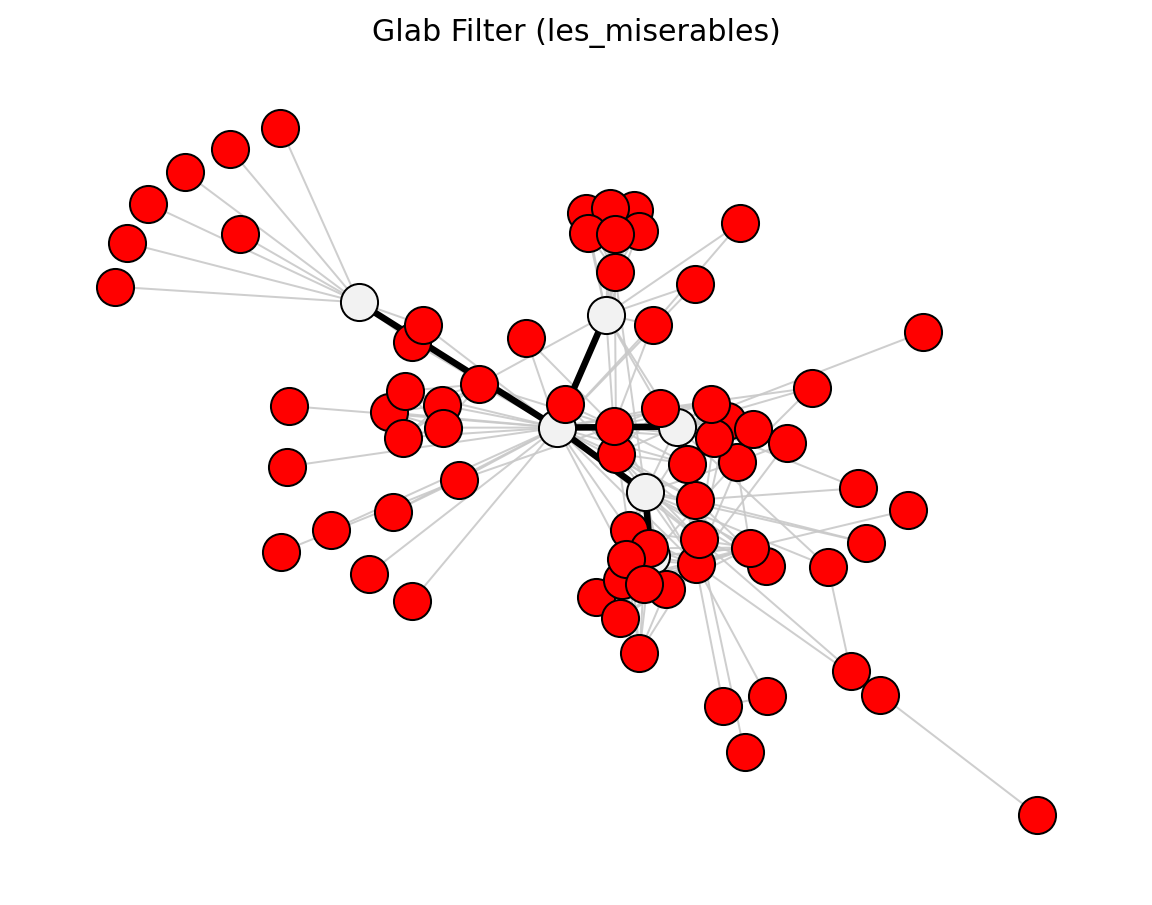
Zhang et al. (2014) – Globally and Locally Adaptive Backbone. Combines disparity filter with high salience skeleton.
- networkx_backbone.glab_filter(G, weight='weight', c=0.5)[source]#
Compute GLAB (Globally and Locally Adaptive Backbone) p-values.
The GLAB method [1] combines global and local information. For each edge it computes an involvement score — the fraction of all shortest paths that pass through the edge — and then tests significance using a degree-dependent null model.
The p-value is computed as:
p(e) = (1 - I(e))^((k_u * k_v)^c)
where I(e) is the edge betweenness centrality (involvement), k_u, k_v are endpoint degrees, and c controls degree influence.
- Parameters:
G (graph) – A NetworkX graph.
weight (string, optional (default="weight")) – Edge attribute key (used as
distance = 1 / weightfor shortest-path computation).c (float, optional (default=0.5)) – Involvement parameter controlling degree influence.
- Returns:
H – A copy of G with a
"glab_pvalue"edge attribute.- Return type:
graph
References
[1]Zhang, X., Zhang, Z., Zhao, H., Wang, Q., & Zhu, J. (2014). Extracting the globally and locally adaptive backbone of complex networks. PLoS ONE, 9(6), e100428.
Examples
>>> import networkx as nx
>>> from networkx_backbone import glab_filter, threshold_filter
>>> G = nx.les_miserables_graph()
>>> H = glab_filter(G)
>>> backbone = threshold_filter(H, "glab_pvalue", 0.05, mode="below")
>>> backbone.number_of_edges() <= H.number_of_edges()
True
Computational complexity estimate is
O(nm + n^2 log n)time andO(n + m)space.
Gallery Examples#
Function Image Reference